Showing posts with label CSR. Show all posts

Wednesday, September 20, 2017

My father wanted a Bengali girl for me, I needed a boy: India’s first Miss Trans Queen

The 26-year-old realised she was a woman trapped in a man’s body when she was just a child and has seen a lot of heartbreaks and broken friendships after she decided to change her gender.

She started the transformation process through hormone replacement therapy (HRT) after she moved to Delhi and has held her high ever since.

Nitasha, who is pursuing a management course, will now represent India in the Miss International TransQueen in Thailand in March 2018.

We caught up with the Kolkata girl to get a peek into her life’s struggles, her beliefs, and how her Miss Trans Queen title could change things for the transgender community in India.

How long does the transition process take to change one’s gender?

It takes around three to four years. Throughout the process, I was talking with my psychologist and my cousin brother. It’s tough because you need to understand who you are as a person and who you are as a soul.

When did you realise you wanted to be a woman?

Right from childhood. When my school friends from St Xavier’s went to play football, I stayed home. I was fond of badminton though and played a lot. But, mostly I was nurtured within the walls of my house and watched TV and stayed home. My mother died when I was very small so my dad played the role of a mother and father both. My brother (seven years elder) also supported me a lot because I came out to him in Class 6, though I knew about myself since Class 4.

He thought that it was a phase I was going through and that I would fall out of it and start liking girls, but I told him I am a girl myself. In fact, when I was in Class 10 he told me that it’s high time I started watching p**n. So, he gave me an adult CD and I gave it to my father, who freaked out. My brother didn’t talk to me for a week. After finishing my schooling from St Xavier’s and graduation from National Institute of Media and Communication, I moved to Delhi to start my transition phase.


What sort of reactions did you get when you told people you wanted to change?

I had a lot of friends leaving me and people talking behind my back. Initially, I felt bad but I held my head up high. I hardly had any friends during that phase. It was basically my friend Raunak, who was there for me, and my father, back in Kolkata.

When I finally came out to my father, I told him, “I am the reincarnation of your wife, so you cannot throw me out. This is when I was in Mumbai, had become a girl, and my father had come to meet me.”

Even before my transition, my father was trying to convince me that I should get married and that he would look for a Bengali girl for me. Which is when I told him, “But I want a Bengali boy!”

What are the issues faced by transgender women in India?

There is a lot of discrimination; there are rapes and no family support. When a person is taking such a decision, the family just throws them out. When you go out and people look down on you, it feels really bad. Due to this 70% of the transgender population is going under depression because society discriminates against them and looks down upon them. There is no monetary or job support and many end up in the s*x trade.

Sometime back, I also came to know about a transgender woman who was not accepted by her family due to which she decided to leave her house. She ended up in a circus, performing as a freak show. Though people used to laugh at her, she used to feel good because she could finally be what she thought herself as. But, the situation kept worsening for her, and ultimately when she died, there was no one there to even cremate her.


What needs to be done for the transgender community in India?

There need to be a lot of employment programmes. Thai airlines, PC Airways has [transgender women] air hostesses working with them, why not Indian airlines? Why not Indigo? Why not Vistara and the others? There need to be special boards formed that help provides money to transgender women for their education. There also needs to be a lot of awareness and education about transgenders in the villages. I even have a book coming out in a few months titled, “Nitasha: The voice of many” by Alka Vasudeva. She had seen me and said she wanted to write a book about me.

There also needs to be member of Parliament (MP) seats for transgenders. Only a transgender MP can understand the issues our community is facing.

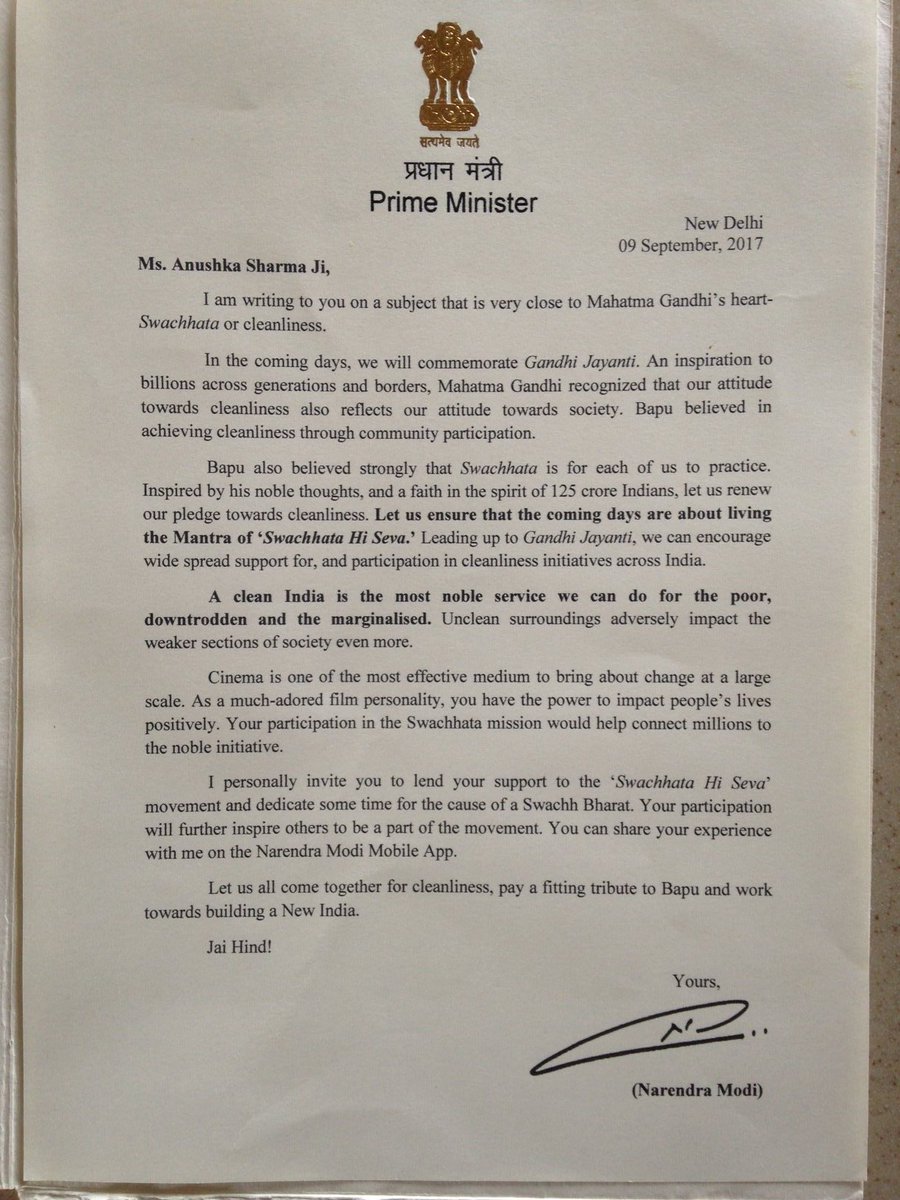
PM Narendra Modi has a special request for Anushka Sharma

Three years after Prime Minister Narendra Modi's pet project Swachh Bharat Abhiyan was launched, the movement is set to become bigger. PM Modi is reaching out to celebrities and inviting them to be a part of Swachhata Hi Seva, a campaign which will "encourage widespread support for, and participation in cleanliness initiatives across India" in the days leading up to the birth anniversary of Mahatma Gandhi.

Anushka Sharma was one of the celebrities he reached out to, and the actor took to Twitter to announce her association with the campaign. Along with the picture of the letter, she wrote, "Happy Birthday to our honourable PM @narendramodi ji. Thank you Sir for the invitation to join the #SwachhataHiSeva movement. I am honoured to be a part of #SwachhBharat campaign and will do my best for the noble initiative of #SwachhataHiSeva."


On the work front, Anushka was last seen on the big screen in Imtiaz Ali's Jab Harry Met Sejal. She is currently working on her production, Pari, which she will also star in. Apart from this, she will be seen in Rajkumar Hirani's Sanjay Dutt biopic, Aanand L Rai's film in which Shah Rukh Khan will play a dwarf as well as a Yash Raj film titled Sui Dhaaga - Made in India.

Friday, August 11, 2017

Why are dogs turning blue in this Mumbai suburb? Kasadi river may hold the answer

As many as five such dogs have been spotted so far.
Why are dogs near Navi Mumbai’s Taloja industrial area turning blue? Untreated industrial wastes being released into the Kasadi river may be the answer. As strays often wade into the river for food, the waste is dyeing their fur a bright shade of blue. On Wednesday, the Navi Mumbai Animal Protection Cell took pictures of a dog whose fur had been dyed blue.

The group filed a complaint with the Maharashtra Pollution Control Board (MPCB) on Thursday, saying animals in the area were suffering because dyes were being released directly into the river by industrial units. The area has nearly a 1,000 pharmaceutical, food and engineering factories.
“It was shocking to see how the dog’s white fur had turned completely blue,” said Arati Chauhan, resident of Navi Mumbai who runs the animal protection cell. “We have spotted almost five such dogs here and have asked the pollution control board to act against such industries,” she added.

As stays often wade into the river for food, the waste is dyeing their fur a bright shade of blue.
The polluted water is also likely to affect human health. In August 2016, fishermen were concerned that the polluted river water was affecting the stock of fish. They collected samples from the discharge of the common effluent treatment plant, which 300 industrial units use to treat their waste.

A water quality test at Navi Mumbai Municipal Corporation found the waste treatment was inadequate. The levels of biochemical oxygen demand (BOD) – the concentration of oxygen required to sustain aquatic life – was 80 milligram per litre (mg/L). Levels of chloride, which is toxic harms vegetation, aquatic life and wildlife, were also high. According to Central Pollution Control Board guidelines, fish die when BOD level are above 6 mg/L.
Levels above 3 mg/L make the water unfit for human consumption.HT had reported that untreated industrial waste pumped out by the plant had raised pollution levels in the Kasadi River to 13 times the safe limit.
The polluted Kasadi river.
“After numerous complaints to MPCB over the years, only the stench at Kasadi has reduced. However, the pollution levels continue to be extremely high and dissolved oxygen is negligible,” said Yogesh Pagade, member of a local fishing community who had conducted the study last year.

MPCB officials said they had taken cognisance of the complaint. “Allowing the discharge of dye into any water body is illegal. We will take action against the polluters as they are destroying the environment,” said Anil Mohekar, regional officer, MPCB, Navi Mumbai. “We have directed our sub-regional officer to investigate,” he added.
Animal rights activists have, however, asked whether the move comes too late. “We have only spotted blue dogs so far. We do not know if birds, reptiles and other creatures are affected or if they have even died owing to the dye discharged into the air,” said Chauhan.

Monday, February 27, 2017

India Just Broke a World Record With Its New Solar Farm

In Brief
  • India is now home to a 10 square kilometer (over 6 square miles), 648 MW solar farm, the largest in the entire world.
  • The country has one of the fastest growing economies and is getting increasing amounts of energy from renewable sources.
China may be the largest producer of solar energy in the world, but neighboring India is no less ambitious when it comes to renewable energy. Expected to become the world’s third-biggest solar market after China and the USA, it is putting its money where its mouth is. A case in point: the country has just put the world’s largest solar power plant into service.
This is good news not just for India’s future energy security but also for its people’s short-term energy needs.

Beating Records

The Adani Group’s new site in the southern Indian state of Tamil Nadu covers an area of 10 square kilometers and has a capacity of 648 megawatts (MW). This is nearly 100 MW more than the previous record-holder, the Topaz Solar Farm in California.
The plant was built in only eight months, comprises 2.5 million individual solar modules and cost $679m to build. It is estimated that it will produce enough electricity to power about 150,000 homes at full capacity.
Made up of five plants in a single location, the solar photovoltaic project has helped push India’s total installed solar capacity across the 10 gigawatt mark, which only a handful of countries can claim.


Installed solar capacity and cost in India. Image: Bridge to India
 

Leading the World in Renewables

A signatory of the Paris Agreement, India is forecast to meet its renewable energy commitments three years early and exceed them by nearly half. The country is aiming to generate nearly 60% of its electricity from non-fossil sources by 2027.
Solar is a particular focus: it makes up only 16% of renewable energy capacity now but is set to contribute over half of the renewables target by 2022: 100 gigawatts of 175 GW. Large installations will be key to achieving this, and the government is planning 33 solar parks in 21 states, with a capacity of at least 500 megawatts each.

Plugging a Gap

Prioritizing solar is not just an investment in the future, though. India is one of the world’s fastest growing economies, and its energy use has doubled since 2000, according to the International Energy Agency.
Last year, the country declared that it had a power surplus for the first time ever, though The Hindu reported that 300 million people still don’t have access to electricity and power cuts continue to be ‘rampant.’ The issue, it appears, is that capacity remains unused in the grid because some state power companies simply cannot afford to buy sufficient electricity.
The Indian government has recently launched an energy ‘blueprint’, and raised its investment target for solar energy to $100 billion in an attempt to address both these near-term issues as well as securing its energy supply far into the future.
This will be important even if China is about to overtake India with an even larger solar power plant which is capable of producing 850 MW of power, enough to supply up to 200,000 households.

Tuesday, January 24, 2017

We will change A. R. Rahman and Viswanathan Anand - PETA

The two faced organization PETA, which is earning the wrath of the Tamil people and their brethren who support them all over the world, continues to raise the bar by coming out with more self serving statements.

The latest is PETA spokesperson V. Manilal who has stated that music maestro A. R. Rahman and chess wizard Viswanathan Anand are wrongly supporting Jallikattu and he and his organization are planning to meet the legends and change their views about the ancient sport of cultural significance.

Friday, January 20, 2017

Preserve our tradition': Thousands gather on Chennai's Marina beach to protest jallikattu ban

“Vendum vendum Jallikattu vendum!”
We want Jallikattu!

“Maramattom maramttom! Kalai adakum varai oya mattom...”
We won’t change! We won’t change! We will not stop until we tame the bull.

“Tamilan endru solla da, thalai nimirthu nilla da!”
Say you are a Tamilian, stand with your head held high!

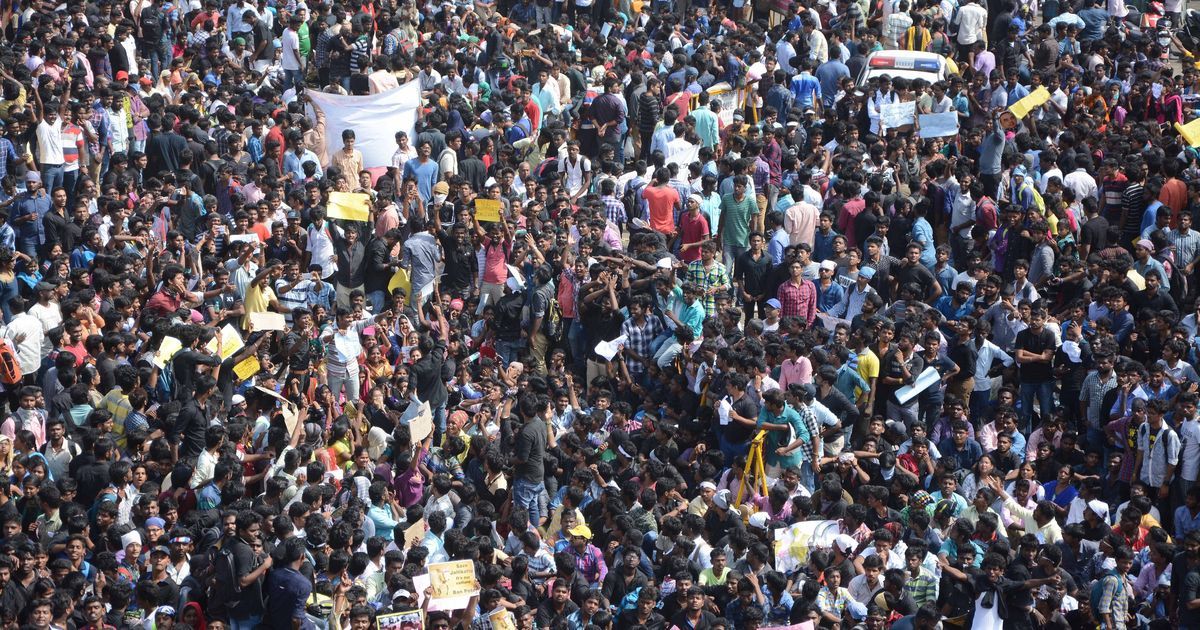
At noon in Chennai, the chants of young jallikattu supporters on Marina beach were growing stronger. Thousands of people had gathered along the beach to protest against the Supreme Court’s decision last January to ban the Tamil bull-taming sport jallikattu.
The sport is traditionally practiced around the Pongal festival, which was celebrated last week.
Along a 3 km stretch of beach, college students, school students and office-goers waved placards and posters supporting the sport. The protest had gathered momentum on Tuesday evening, and many had stayed overnight on the beach, refusing to move until the ban was revoked. Even though it was more than 36 hours since the protest began, hundreds were continuing to throng at the beach.
“Only now the protest is gathering momentum,” said V Balaji, a college student.
The clamour in support of the sport has been growing louder across the state over the past month. The Supreme Court has been hearing several petitions on the sport since it was banned on 2014. After upholding the ban last January, the Supreme Court bench in November referred to jallikattu as a “gladiator-type sport” and said that it was a Constitutional obligation to show compassion to animals.
As sporadic protests erupted in parts of the Tamil Nadu, several political leaders made promises to the public that jallikattu could be conducted during Pongal 2017. Last week, Chief Minsiter O Panneerselvam wrote a letter to Modi urging the centre to quickly pass an ordinance to allow jallikattu bouts to be organised. But the Supreme Court refused to pass a judgement before Pongal.
Ignoring the ban, jallikattu bouts were reportedly organised in several villages near Madurai and Sivaganga towns in Tamil Nadu. In Alanganallur near Madurai, more than 500 supporters were detained by the police.
On Wednesday, supporters at Marina beach were calling out to political leaders demanding that their promises be fulfilled. They shouted slogans naming chief minister Panneerselvam and All India Anna Dravida Munnetra Kazhagam chief N Sasikala, who is also known as Chinamma or Little Mother.
“Ringa ringa roses, enga ponaan OPS?”
Where did O Paneerselvam go?

“Chinamma Chinamma, OPS enga ma?”
Chinamma, where is OPS

“Vyavasayi kana la kaneer, enga ponaan Panneer?”
Farmers have tears in their eyes, where did Paneerselvam go?

College students gathered at the protest.

Social media mobilisation

Around midday, busloads of students were constantly pouring into Kamarajar Salai, the road along Marina Beach, joining the chorus of slogans supporting jallikattu.
“We got messages from different groups on WhatsApp and Facebook,” said L Shruthi, a student of Ambedkar Law College. “We were told that if all college students bunk class and gather here, the national media will come.”
M Manimaran, a third-year law student, had been at the Marina beach since Tuesday morning, tossing bottles of water and food packets to all those gathered. A first-generation high-school graduate, Manimaran’s family was dependent on agriculture until his father moved to the city when Manimaran was a child. But he often visited his grandparents’ home in their native village of Ramanathapuram in Sivaganga district, where jallikattu was practiced until three years ago. “My father and grandfather have all played jallikattu in their youth. We want to preserve that tradition,” he said.
Manimaran had been at the beach since Tuesday morning. “My father too encouraged me to come here and protest,” he said.
A few hundred people had been protesting on the beach since Sunday, after jallikattu supporters in Madurai district had been detained by the police, said Manimaran. As word about the demonstrations spread on social media, thousands more joined in.
On Tuesday, the street lights along an entire section of the footpath where the protestors stood were switched off. “The police used that tactic hoping that we would all clear off,” said Manimaran. “But instead it triggered off a lot more anger. People started waving their phone torches in protest.”
Credit: Marina Beach/Facebook

‘Ban PETA’

Along with the slogans protesting against the jallikattu ban were calls to ban the NGO People for the Ethical Treatment of Animals, or PETA, the animal welfare organisation that had expressed its support for the court-imposed restriction on the sport.
According to V Balaji, a student of Alpha Arts and Science College, the organisation did not understand the nuances of the sport. “Farmers spend so much of their money to rear their cattle,” he said. “Why would they want to hurt them?”
Balaji said that jallikattu itself had many rules that prevented the animals from suffering harm. He said that a participant in the sport could be disqualified if more than one person caught the neck of the bull or the hump.
“Everybody here knows that big multinational dairy companies are backing PETA,” said V Balaji. “They want to destroy our native breed of cattle and bring in jersey cows.”
The view that western corporations were behind the ban was shared by several other at the rally.
“If we don’t conduct jallikattu, the purpose of breeding bulls will be lost,” said R Palani, an IT employee. “Foreign MNCs want us to consume the milk provided by foreign varieties of cattle. This kind of milk can gave us diabetes and even cancer. Then they want to sell us their medicine for cure. That is the truth.”

AR Rahman to go fast in support of Jallikattu on Friday, Score other personalities join the bandwagon


Thousands have been protesting at the Marina Beach in Chennai from Tuesday onward against a court ban on Jallikattu, the controversial bull-taming sport played during the Pongal festival. The repeated neglect of Tamil identity is the rallying point for Jallikkattu protests.

Since the issue has snowballed into a controversy, prominent National figures from the state have come out open in support for the sport.

Oscar winning musician AR Rahman is the latest one to join the debate. He said that he will go on fast on Friday to support the spirit of Tamil Nadu. He said this in a tweet.

Chess champion Viswanathan Anand has also come with the support for the protest. He said "My state rises again in unison, in peace. Proud to be a #tamizhanda. Genext here are modern yet culturally rooted"

Many Tamil superstars including Rajnikanth, Kamal Hassan, Dhanush, Surya, Vishal, Sivakarthikeyan, Cricket Ravichandran Ashwin and scores others have lending their support for the Jallikkattu.

We do Jallikattu: Protests erupt across Tamil Nadu as thousands brace up to defy the SC order


Hours after the Supreme Court rejected a plea inviting its interference to allow Jallikattu during this Pongal, protests erupted across Tamil Nadu. The police had to resort to lathicharge to control the situation at several places. More than two dozen people were arrested for illegally holding Jallikattu in Cuddalore town.

The chorus in support of the sport grew with more sections of people, including students, joining protests in different parts of the state, including in places where it is not so popular.

Students of state-run Anna University and Dr Ambedkar Law University took to the streets in support for Jallikattu. While Anna varsity students staged a sit-in protest, law students took out a rally here. Similar demonstrations were held by students in various places, including Vellore, Pudukottai and Tirupur.

A students’ protest in Madurai turned violent when police resorted to a lathicharge to disperse them. The agitators said it was a peaceful protest and they were on their way to the collector's office to submit a letter in support of the Jallikattu when police stopped them.
 
About 10,000 people converged at a ground in Coimbatore in support of Jallikattu, while protests were staged in Sivaganga, Dindigul, Pudukottai and Salem districts.


Both the ruling AIADMK and Opposition DMK came out with statements portraying the importance of Jallikattu to Tamil culture, and vowed to push the Centre in this regard.

The bull taming sport Jallikattu, organised to celebrate Pongal festival, has not been held in Tamil Nadu for the last two years. It was first banned in May 2014 by the apex court. In 2016 though the Centre permitted the event, the court stepped in and stayed it. Animal rights groups oppose the sport on the grounds of cruelty to animals.

DMK working president, MK Stalin, announced on Thursday that his party would hold protests in every district of the state on Friday to “force the Centre to allow the sport”. AIADMK spokesperson C Saraswati dubbed the apex court decision as “unfortunate,” and said the state government would do everything in its power to ensure that the event is held.

Stalin also participated in a demonstration held by college students here seeking permission for jallikattu. “I extended support for the agitation by participating in their protest. It is welcome that students are holding protests for Jallikattu,” he said.

He said only such solidarity and participation by students “guarded our mother tongue”, in an apparent reference to the large scale anti-Hindi protests by students in 1960’s. “Similarly, I believe that students’ agitations will protect jallikattu, the cultural symbol of the Tamil people,” Stalin said.
Functionaries of Naam Tamizhar Katchi conducted Jallikattu in Cuddalore near the Thiruvanthipuram Devanatha Swamy Temple premises and police arrested 28 people for violating the ban.

Film personalities including actor Sathyaraj, filmmaker Karu Pazhaniappan participated in a stir here pledging support for Jallikattu. Actor Simbu held a silent protest.

In Coimbatore, people from different spheres of life, cutting across caste, linguistic and political barriers, took part in the protest at the sprawling CODISSIA grounds under the banner of “Voice for Jallikattu”.

The protests over Jallikattu in Tamil Nadu had its echo in the neighbouring union territory of Puducherry where volunteers of various youth outfits staged a human chain agitation supporting the bull taming sport on the ground that it was part of the time-honoured tradition of the Tamils.

The Supreme Court on Thursday rejected a plea seeking its intervention to lift the ban on Jallikattu before Saturday saying it is “unfair to ask bench to pass an order” while the draft of the judgment has been prepared.

Thursday, January 19, 2017

Foreign Media On Jallikattu And The Backlash Against PETA


Foreign Media On Jallikattu And The Backlash Against PETA
Thousands of angry young people flocked to the streets on Wednesday in southern India to protest a three-year-old ban on an ancient bull-taming festival that animal rights activists say is cruel.

In a bitter clash that pits cultural traditions against the campaign for animal rights, the annual harvest-related bull-taming sport called Jallikattu has sharply divided Indians in the past week.

The popular ritual traditionally takes places in villages of the southern state of Tamil Nadu in January. But this is the third year that the event has been banned, and many people are now calling for India's Supreme Court to overturn the prohibition.


On the day of the harvest festival, villages across the state typically conduct competitions where the bulls are tied and kept in an excitable state until doors are opened. As the bulls run out, participants chase them and try to tame them by holding on to their humps for as long as they can. This year, the festival was held on Saturday - most villages complied with the bull-taming ban, but a few defied it.

For the last two days, tens of thousands of protesters have lined up along the roads, public squares and beaches across the state to show their support for the bull-taming festival. Some men even buried themselves neck-deep in beach sands to protest. Students skipped classes in schools and colleges to join the crowds. Several Tamil movie actors and directors have also called for Jallikattu to be revived.


"Jallikattu is our tradition, it is our identity. We will not allow anyone to play with our emotions," said Manoj Kumar, a college student and protester, said in a phone interview from Chennai, the capital of Tamil Nadu.

The Times of India newspaper called it a "Tamil Nadu version of the Arab Spring."

"These bulls are like children in our families, we do not torture them. This is how we play with them," said C. R. Lakshmi, the spokeswoman for All India Dravida Munnetra Kazhagam, the party that is in power in Tamil Nadu. "This festival goes back thousands of years, and this is an integral part of our harvest festival. Women in the ancient tales would say that they would only marry the men who can tame the bulls. Villagers now say there has been a drought in the state because of the ban on Jallikattu."

The Supreme Court is now considering a number of appeals against the ban by the state officials. Animal welfare groups like the People for the Ethical Treatment of Animals (PETA) are supporting the ban, saying that the animals are tortured to heighten the excitement of the spectator sport. The court's verdict is expected soon.

"International groups like PETA do not understand Indian culture. Why don't they first try to ban bull racing in Spain?" Lakshmi added. (PETA does advocate against bull fights and bull runs around the world.)

India's law against cruelty to animals lists bull fighting, dog fighting, bull racing and other uses of some animals in performances. In 2011, India's environment ministry banned the use of bulls in performances across India. In 2014, the Supreme Court said that spectacles like Jallikattu violate the law.

Jallikattu advocates say the sport must be regulated instead of being banned completely.


But animal rights activists say that people had violated many of the regulations stipulated by the court before 2014 and argue that the sport is inherently violent. PETA members have submitted films that showed chili powder being inserted into the nostrils of the bulls, their tails twisted and bitten by participants, and bulls being prodded with sticks and fed with suspected alcohol.

Hundreds of people have been injured and some killed during the sport in recent years.

Many protesters called for a ban on PETA. One prominent politician in Chennai said last week that PETA is an "anti-national" group.

Manilal Valliyate, the Indian director of PETA, said that the country's law "makes it the mandate of every Indian citizen to have compassion for animals. To stand for kindness is patriotic, to stand for cruelty is un-Indian." He added that PETA does not make laws, but is "a law-abiding body," and targeting it is "cheap and ineffective."

But Valliyate said, "to prevent cruelty to bulls, which is inherent in Jallikattu, ban is the proper, sensible, commonsensical solution."

Another PETA statement said that the purpose of the annual harvest festival is "to thank the nature and celebrate life, something that can't be achieved by tormenting bulls and causing human and bull injuries and deaths."

PETA members have been getting threatening calls and emails from protesters, Valliyate said.

"The spontaneous uproar against the ban shows that people are upset with the court and the national government in Delhi, which they say is trying to portray them as a bunch of villains," said Nityanand Jayaraman, an environmental activist in Chennai. "There are better ways of addressing such issues without banning them."

Officials in Tamil Nadu have urged Prime Minister Narendra Modi to bring an amendment to animal welfare law in the next session of the national parliament, and introduce an ordinance for "removing the legal impediments" to the sport.

But animal welfare activists wore the mask of bulls this week and protested the move. They held placards in New Delhi this week that said "Please Mr Modi: Stay Strong. Don't Weaken Bull Protection Laws."

Sea of protesters at Chennai's Marina Beach as pro-Jallikattu protests continue across Tamil Nadu

What started out as a show of solidarity with protesters in Alanganallur in Madurai district became a full-blown show of strength of jallikattu supporters across Tamil Nadu on Wednesday with youngsters, mostly college students, taking the lead.
If Alanganallur was the epicentre of the pro-jallikattu protests on Monday and Tuesday, the focus gradually turned to the Marina Beach in Chennai by Tuesday night with protesters who assembled there earlier in the day refusing to leave the venue. Their protest continued overnight, and they stayed put even when streetlights were switched off.

By Wednesday afternoon, Marina Beach became a sea of protesters with people joining the crowd minute by minute. Several college students bunked classes to be at the protest venue. The protesters refused to disperse saying they would leave only if chief minister O Panneerselvam gave them an audience and ensured the conduct of jallikattu.

However, Panneerselvam stayed away from Marina Beach. He avoided taking the Kamarajar Salai when he went to Secretariat in the morning, in a bid to avoid running into the agitated crowd. Instead, he took the Anna Salai route. The chief minister held talks with senior police officials who informed him about the gravity of the situation.

In the evening, Panneerselvam announced that he would meet Prime Minister Narendra Modi in New Delhi on Thursday to persuade him to promulgate an ordinance for the conduct of the traditional bull-taming sport.
Slogans were raised against People for Ethical Treatment of Animals (PETA), Modi, Panneerselvam, AIADMK general secretary VK Sasikalaa and almost anyone the protesters perceived as anti-Tamil during the course of the day.

Traffic blocks and diversions were seen on several roads in Chennai throughout the day. Kamarajar Salai that goes via Marina Beach and Old Mahabalipuram Road (OMR), where lots of educational institutions and IT parks are situated, were the worst affected roads.

Traffic OMR when the students of the Sathyabama University staged a pro-jallikattu protest. Later in the day, techies also held protests on the OMR.

Meanwhile, protest continued for the third day at Alanganallur in Madurai district. In Madurai city, youngsters staged a protest on Tamukkam grounds on Wednesday morning. In Kovilpatti in Tuticorin district, police arrested several protesters who attempted to take out a rally against PETA.

A student suffered injuries when he jumped off a pole during a protest at Vaniyambadi in Vellore district. K Suresh, a second year student of Priyadharshini Polytechnic College, climbed on an electric pole in front of the college around 1pm. Before jumping off the pole, he shouted slogans against PETA and demanded that the central government take steps to lift the ban on jallikattu.

He was rushed to Government Hospital in Vaniyambadi. The doctors examined him and told his friends that he sustained fractures on his right leg and left hand. He was referred to Government Vellore Medical College Hospital.

Students boycotted classes and staged protests in Trichy, Coimbatore, Salem, Krishnagiri and other parts of the state.

Thursday, January 5, 2017

An Indian chemical plant has figured out how to turn its carbon emissions into baking soda


This could solve a lot of problems.

A chemical plant in India is the first in the world to run a new system for capturing carbon emissions and converting them into baking soda.

The Tuticorin Alkali Chemicals plant, in the industrial port city of Tuticorin, is expecting to convert some 60,000 tonnes of CO2 emissions annually into baking soda and other chemicals – and the scientists behind the process say the technique could be used to ultimately capture and transform up to 10 percent of global emissions from coal.

While carbon capture technology is not a new thing, what's remarkable about the Tuticorin installation is that it's running without subsidies from the government – suggesting the researchers have developed a profitable, practical system that could have the commercial potential to expand to other plants and industries.

"I am a businessman. I never thought about saving the planet," the managing director of the plant, Ramachadran Gopalan, told the BBC.

"I needed a reliable stream of CO2, and this was the best way of getting it."

The inventors of the new technique, London-based Carbon Clean Solutions, developed the system in the UK after receiving finance from a British entrepreneur support scheme. Their process uses a patented chemical to filter out CO2 molecules.

In the Tuticorin setup, the plant runs a coal-fired burner to make steam that powers its various chemical-manufacturing processes. A mist containing Carbon Clean's chemical separates the CO2 emissions in the burner's chimney, which are then fed into a mixing chamber with salt and ammonia.

The end product can then be used to produce baking soda (sodium bicarbonate) or a range of other compounds, for use in things such as glass manufacture, detergents, disinfectants, and sweeteners.

The overall idea of separating CO2 molecules from flue gas may not be new, but the team behind the system say that their filtering chemical is more efficient than the amine compounds that scientists have previously used, and requires less energy to run.

According to CEO Aniruddha Sharma, the company's approach is to think realistically, partnering with modest, low-risk enterprises as it builds itself up – and he says the same strategy should be implemented by the carbon capture industry as a whole.

"So far the ideas for carbon capture have mostly looked at big projects, and the risk is so high they are very expensive to finance," Sharma told Roger Harrabin at The Guardian.

"We want to set up small-scale plants that de-risk the technology by making it a completely normal commercial option."

The other compelling aspect of the system is that it actually does something positive with the carbon – making new chemicals and products – rather than simply storing it somewhere in a useless, dormant state (such as burying it underground).

That distinction is the difference between carbon capture and storage (CCS) and what's called carbon capture and utilisation (CCU).

And given the expense involved with building carbon capture systems, the ability to on-sell a byproduct could be incredibly important in making this technology financially viable in the bigger picture.

"We have to do everything we can to reduce the harmful effects of burning fossil fuels," Lord Ronald Oxburgh, the head of the UK government's carbon capture advisory group, told the BBC, "and it is great news that more ways are being found of turning at least some of the CO2 into useful products."

Sunday, October 12, 2014

Parental Awareness, Understanding Key to Preventing Suicide Among Young Adults

Parenting is one of the most challenging responsibilities a human being will ever take on. A particularly daunting challenge parents face is determining whether their offsprings who are late teens or young adults (ages 18 to 24 years) are going through depression, having suicidal thoughts, or just going through a brief period of “the blues”, according to Yellowbrick, a national psychiatric center of excellence in Evanston, Illinois.
Vulnerable age group
In the United States, young adult and teen suicide is the third leading cause of death for those between ages 10 and 24, according to the U.S. Centers for Disease Control and Prevention (CDC).

The Global School-based Student Health Survey conducted in the Philippines in 2003, 2007 and 2011 by the World Health Organization found that…
…approximately 1 in every 5 Filipino students in public high schools aged 13 to 15 has seriously considered attempting suicide. About 1 in 10 actually attempt suicide. 
Stonewalling parents
The State Adolescent Health Resource Center of the Konopka Institute, University of Minnesota explains that young adults and late teens are in the stage of development in which they develop a sense of self as an individual and as a person, moving from identifying themselves as an extension of their parents (childhood) to recognizing their uniqueness and separation from their parents.

Yellowbrick warns that “young adults and late teens may be closed-off and unwilling to talk with their parents or other influential adults.”
Yellowbrick-Parenting-Young-Adults-Suicide-and-Depression-Answers
Source: yellowbrickprogram.com
Tips for parents
Yellowbrick offers the following tips parents can use to support young adults going through depression or who may be having suicidal thoughts:

1. Look for warning signs.
Although studies show that there is no reliable indicator for impending suicide, there are warning signs an emerging adult is at risk for suicide. These include:

• Secrecy
• Isolation
• Depression
• Expressions of despair

2. Watch out for mental illness.
Any form of mental illness, such as depression (especially bipolar depression), can increase a young adult’s risk of suicide. Individuals with anorexia nervosa have a high rate of suicide and death due to the effects of starvation on mood and judgment.

Anorexia nervosa is an eating disorder that causes people to obsess about their weight and the food they eat.
People with anorexia nervosa attempt to maintain a weight that is far below normal for their age and height. To prevent weight gain or to continue losing weight, people with anorexia nervosa may starve themselves or exercise excessively.
Anorexia nervosa is more common among female teenagers. According to the Mayo Clinic, teenagers may be more susceptible because of all of the changes their bodies go through during puberty. They also may face increased peer pressure and may be more sensitive to criticism or even casual comments about weight or body shape.
3. Be aware that substance abuse and addiction significantly increase suicide risk.
Smoking, drinking alcohol and use of illicit drugs (e.g. marijuana, shabu, etc.) accelerate the risk of suicide from other mental illness while also carrying a three-fold higher rate of death than suicide from accidental overdose.

The 2013 Young Adult Fertility and Sexuality Study (YAFS) showed that 1 in 5 Filipinos aged between 15 and 24 years smokes while 1 in 3 drinks alcohol. Metro Manila recorded the highest proportion of youth smokers (27 percent). Only four percent or 767 of the 19,178 survey respondents admitted to using illegal drugs.
4. Check your family history and your children’s friends
Many forms of mental illness and addictions have a genetic component, i.e. they can be inherited. As such, a family history of suicide is a risk factor. Peer influences can also increase a young adult’s risk of suicide.

How to support a young adult who has attempted suicide
Parents need to keep a close watch on a young adult who has attempted suicide. Young adults who have tried to take their own life are at increased risk of making another suicide attempt.

z11
A warning from Yellowbrick: “Feelings of shame and guilt triggered by the suicide attempt may increase actual or perceived social isolation and personal failure, which can heighten pre-existing emotional tensions in a young adult. Feelings of irreparable isolation and/or loss are a key driver of suicide.”

After a failed suicide attempt, many individuals feel intensely ashamed, guilty, and isolated. Parents need to be absolutely non-judgmental, demonstrate acceptance, and offer support. Empathy is key, particularly if the young adult is angry he or she survived the suicide attempt, which is common among suicide survivors.
Instead of feeling responsible for “reading” the young adult’s mind, parents should establish safe, honest and open communications to allow their child to come forward for help. They should help their child repair and sustain connections with others and enable their child to return to activities that offer a sense of meaning and competence.
“Parents should seek professional assistance to understand the emotional and neurobiological contributors to the young adult’s experience that resulted in the suicide attempt,” Yellowbrick says.
Operating from a research-based care model that combines cutting-edge neuroscience, innovative psychotherapies, rehabilitation strategies and wellness medicine, Yellowbrick isdedicated to providing a full-spectrum, specialized approach to the emotional, psychological and developmental challenges of emerging young adults.

Thursday, September 11, 2014

Provide Ebola detection facilities at Pune, Nagpur airports

 
The Bombay High Court today directed Maharashtra Government to provide medical screening facilities at Pune and Nagpur airports to detect Ebola virus among passengers arriving from affected countries, on the lines of existing amenities at Mumbai and Delhi airports. 
 
The direction was given by a bench headed by Justice Abhay Oka on a PIL filed by activist Ketan Tirodkar alleging that India was not fully equipped to prevent the spread of Ebola. 
 
The PIL said many persons of Indian origin are leaving African countries due to outbreak of Ebola and returning to India where there are no facilities either to detect or treat the epidemic. 
 
The Union Government today filed an affidavit saying they had taken adequate precautions at the airports to detect Ebola virus among the passengers, following which the bench expressed that prima facie it was satisfied with the measures undertaken by the Centre. 
 
The court was informed that the state government had written a letter to the Director of Medical Education and Research requesting them to make necessary arrangements at Pune, Nagpur and other airports to medically screen passengers who come from the affected African countries. 
 
The Union government has put in place health screening for detection of symptomatic cases. Accordingly, all the travellers who have visited or transited through the affected countries in the last 21 days and have symptoms suggestive of Ebola Virus Disease (EVD) are required for mandatory reporting at health counters, the Centre's affidavit said. 
 
Additionally, health screening is undertaken by the Airport health officials, said the affidavit filed by Dr V L Gokak, Senior Regional Director, Ministry of Health and Family Welfare. 
 
In the health screening by airport officials, all the passengers are screened through a thermal scan and digital thermometer to segregate cases of Ebola virus and to isolate, further investigate and treat such high risk cases in a designated facility, the affidavit said.

About GTG India

GTG India

GTG India
Logo